

Introduction
(Revelation 21:1–5)
“Now I saw a new heaven and a new earth, for the first heaven and the first earth had passed away. Also, there was no more sea. Then I, John, saw the holy city, New Jerusalem, coming down out of heaven from God, prepared as a bride adorned for her husband.
And I heard a loud voice from heaven, saying, ‘Behold, the tabernacle of God is with men, and He will dwell with them, and they shall be His people. God Himself will be with them and be their God. And God will wipe away every tear from their eyes. There shall be no more death, nor sorrow, nor crying. There shall be no more pain, for the former things have passed away.’
Then He who sat on the throne said, ‘Behold, I make all things new.’ And He said to me, And until that day, we say what it says at the end of Revelation: “Even so, come, Lord Jesus, come.” (Revelation 22:20)
SOLOMON AND THE QUEEN OF SHEBA
In 1 Kings 10 King Solomon meets the Queen of Sheba and answers all her questions. He showed his wisdom to the queen, and in the middle of that, she said, “Oh, the half has not been told.”
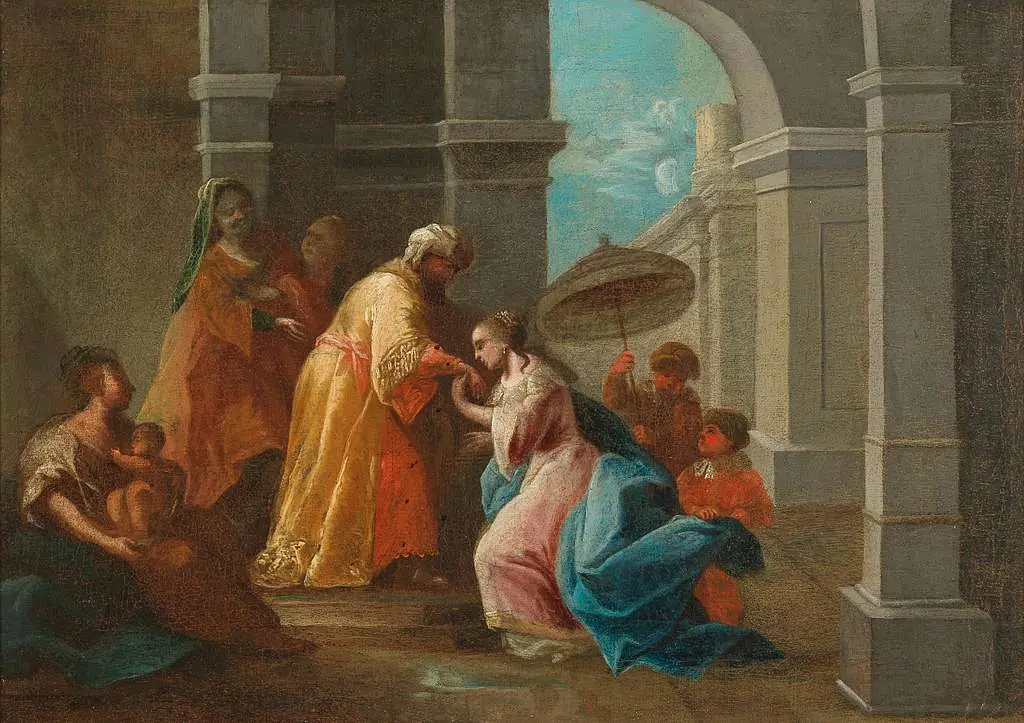
There had been nothing so difficult for the king that he could not explain it to her. When the Queen of Sheba had seen all the wisdom of Solomon and the house he had built, she believed the words she had heard about him. She needed to see it with her own eyes. She told him, “Your wisdom and prosperity exceed the fame which I heard. Happy are your men and happy are these servants who stand continually before you and hear your wisdom.”
She was coming from a very prosperous nation. She had a lot of gold, silver, and gifts. She brought these to Solomon when she saw his wisdom. She recognized that the gifts she brought were good, so she brought more. Solomon began giving her gifts as well. She would bring him gifts, and he gave her all that she asked for. A great thing was happening between the nations at that time.
But she said, “The half has not been told.”
We can relate this story to the story of the woman at the well. (John 4:1–42)
Jesus was on His way to Galilee and went through Samaria. He sat down by a well, as He was weary from travel. While He was there, a Samaritan woman came. He said to her, “Give me a drink.” The woman knew the Jews and Samaritans didn’t usually talk to one another like this, and here He was asking her to give Him a drink.
Jesus said that if she knew the gift of God and who was asking her for a drink, she would have asked Him, and He would have given her living water. She said back to Him, “Sir, give me this water, that I may not thirst, nor come here to draw.” She had perceived that He was indeed the Messiah.
The woman ran back to town and told everyone what had happened at the well. She told them, “Come, see a Man who told me all things that I ever did. Could this be the Christ?”
Many were intrigued and went to see the Man this woman spoke of. When they got there and heard Jesus speak, they believed also. They did not believe because of what they were told, but because they saw for themselves the half that had not been told to them.
THE KINDLING OF THE SECOND GREAT AWAKENING
During the 1740s, the First Great Awakening took place. During this time, there were signs of the providence of God, and it fueled the Revolutionary War. In Robert Morgan’s book, 100 Verses That Made America, he says that evangelical Christianity crashed after the American Revolution. Church attendance dropped to near nothing, and French rationalism swept over colleges. They became hotbeds of atheism.
Thomas Paine’s anti-Christian ravings demoralized the church, and the reorganization of society and its westward expansion left little time for spirituality. Chief Justice John Marshall worried that the church was too far gone to be redeemed.
But a second Great Awakening was on its way.
Carey Allen, a student at Hampden-Sydney College, had embraced Christ in September of 1787, eleven years after the signing of the Declaration of Independence. He and another student, William Hill, began secretly reading a book called Alarm to the Unconverted by Joseph Alleine.
Carey kept this book locked in his trunk because the college was filled with anti-Christian sentiment. When James Blythe found him reading the book, he broke out into tears. He came under conviction and accepted Christ as his Savior.
What do you think might happen if three people started praying and worshiping as these young men did? They were getting in touch with God, and God was getting ahold of them!
The young men had been praying together secretly in the woods, but decided one day to hold a prayer meeting at the college. Someone walked by the closed door and heard the boys singing and praying, and went and spread the word to others.
Soon, a mob of students formed, and they began rioting outside the door where the three boys worshiped together. A couple of professors saw what was happening and sent all the students back to their rooms.
The president of the college, John Blair Smith, got word of this and demanded to know the cause of it all. Some of the most prominent leaders stepped forward and said that some of the students had shut themselves in one of the rooms and begun singing, praying, and carrying on. This mob was determined to break it up.
His eyes filled with tears, and he asked, “Has it come to this?” He saw that some of his students were determined to serve their Savior. He questioned whether it was possible that such monsters of iniquity in this school would set themselves against such things.
President Smith rejoiced that the students had taken a stand for Christ. He assured them that their meetings would no longer be interrupted, and beginning the next Sunday afternoon, the meetings were held in his parlor, where he would join them.
Word of this spread throughout the land and kindled the start of the second Great Awakening.
The president’s father, Robert Blair, heard about it all and stated, “The half was not told me of the display of God’s power and grace among them.”
THE JOY OF SALVATION PRESENT AND FUTURE
The Queen of Sheba said, “I heard about this, but the half had not been told.”
We can apply this to the time of the Queen and Solomon. We can apply it to the time of the Second Great Awakening in the United States.
And we can apply it to the joy of salvation!
Jesus has come that we might have life and have it more abundantly. Right now, He wants to give us an abundant life. There is spiritual warfare going on even now, just as there was for the students at Hampden-Sydney College. But God was greater then, and He is greater now!
Some people suffer tragedy in their lives or have many things come against them. Yet, when they come to the Lord, He delivers them. It might be immediately. Sometimes they struggle. But they do overcome.
It is joy unspeakable and full of glory.
There is also the future joy of Heaven. That joy is an indescribable beauty. It is one with no more sickness and no more sorrow. Just a few years ago, there was a sickness that crippled the nation. It caused us to quit worshiping in some ways. We did things from home in many ways. Finally, many of us just told people they could decide for themselves, but we were having church!
But in Heaven, there will be no more sickness. No more pain or sorrow. Oh, the half has never yet been told! Joy unspeakable and full of glory!
Are there more of us now willing to pray? Are you willing to cry out to God on behalf of our nation? Today, our nation’s issues are not primarily political, but spiritual. Our answers are not found in politics, but in the hope of another spiritual return to God!
Would you like to see it? Are you ready and willing to repent? Is our nation ready to repent?
Scriptures used:
Revelation 21:1–5
Revelation 22:20
1 Kings 10:1–13
John 4:1–42
John 10:10
1 Peter 1:8