
Deuteronomy 12
Introduction: The Woman at the Well
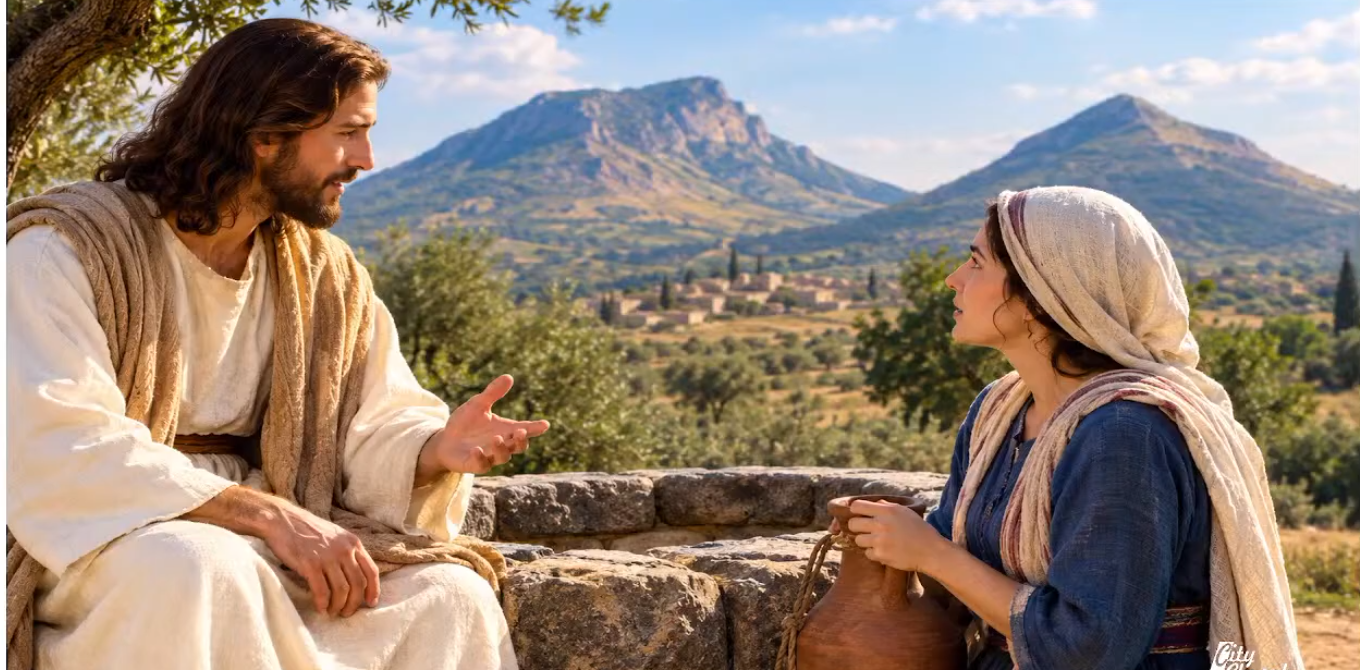
Jesus and His disciples were traveling to Galilee. Rather than taking the usual route, which meant crossing the Jordan River and traveling around Samaria before crossing back over, Jesus continued straight ahead. The disciples questioned His decision because Samaria was on the way, but Jesus was determined to go that direction. After they arrived, He sent the disciples away to get food (John 4:3–8).
It was a divine appointment. A woman came to the well in the middle of the day, with no one else around. Sometimes those moments when there are no distractions give us the opportunity to talk with someone about the Lord. Jesus sat by the well, physically tired from His journey, and began talking with her. When He told her about her five husbands and the man she was living with who was not her husband, she was overcome by His knowledge of her life. As they continued their conversation, she became convinced that He was the Messiah (John 4:16–19, 25–26).
Jesus asked her for a drink, but she was surprised that a Jewish man would speak to a Samaritan woman. Jews and Samaritans had a long history of hostility and generally avoided associating with one another. She was also surprised that He would ask her for water. Jesus told her that if she knew who she was speaking to, she would ask Him for living water and never thirst again. She wanted that water, and that day she came to understand that He was the Messiah.
She went into the city telling everyone, “Come, see a man who told me all things that I ever did.” Many came to hear Jesus for themselves, and later they told her that they believed not only because of her testimony, but because they had heard Him themselves (John 4:7–15, 28–42).
The conversation at the well also connects this story to our passage in Deuteronomy 12. The woman brought up the difference between where the Jews worshiped and where the Samaritans worshiped. Jesus told her that a time was coming when true worshipers would worship the Father in spirit and in truth. This is an important connection because it brings us to the central subject of this passage: how God wants us to worship Him (John 4:19–24).
Center on God and His Truth
We all have our favorites. It might be a favorite chair, restaurant, or even a favorite route to take.

Everybody has a favorite about something. We tend to favor certain things, and sometimes we even approach worship that way. We have our favorite ways of worshiping, but we are to worship God in spirit and in truth.
Have you ever wanted to do things your own way? I know a young man who struggles with this. He wants to do good and do what is right, but sometimes he has a hard time overcoming that desire to do things his own way. Before we point fingers at him, we need to recognize that we all have that tendency. We need to examine our own hearts and ask whether we are willing to be obedient to God as He wants us to be.
In worshipping, the first thing we need to do is center on God. Deuteronomy 12:5 tells us, “But you shall seek the place where the Lord your God chooses, out of all your tribes, to put His name for His dwelling place; and there you shall go.”
Notice that God chooses the place. He chooses where His name will dwell, and He tells His people, “There you shall go.” Verse 14 says: “But in the place which the Lord chooses in one of your tribes, there you shall offer your burnt offerings, and there you shall do all that I command you.”
We need to center on God and do things His way. God told His people where they were to worship Him and where they were to bring their offerings. They weren’t to worship just anywhere or decide for themselves how they would do it. They were to follow His instructions.
There are lots of times God gives us freedom to make our own choices. However, when He tells us what He wants, we need to listen and do what He says.
Deuteronomy 12:8 says, “You shall not at all do as we are doing here today, every man doing whatever is right in his own eyes.” Have you noticed how often that idea appears in Scripture? There was a time when people did what was right in their own eyes, and wickedness became so widespread that God sent the flood.
Verse 28 brings us back to what God expects of us: “Observe and obey all these words which I command you, that it may go well with you and your children after you forever when you do what is good and right in the sight of the Lord your God.”
We need to first of all center on God, but then we need to center on God’s truth. We don’t want to make our own positioning system.
Avoid Idolatry
God tells us in this passage that we are to avoid idolatry. Some would say we probably aren’t tempted to follow false gods today. However, false religions are making more inroads into our culture., so we need to be careful and pay attention to what is happening because there is only one God. We need to be diligent not to be led into following false gods.
God also warns His people not to pattern their worship after false religions. Even when they were worshiping the true God, they were not to worship Him in the wrong way.
In Bible times, there were places called high places. People would sometimes go there and offer sacrifices to the true God. However, those places had been dedicated to the worship of all kinds of false gods. God told His people not to go there or worship Him in the way those false gods were worshiped.
God warned the Israelites that when they entered the land and the nations were driven out before them, they must not become ensnared by the practices of those nations. They were not to inquire how those nations served their gods and decide to do the same. God specifically told them not to worship Him in that way. The nations had practiced things that were abominations to Him, including burning their sons and daughters as sacrifices to their gods (Deuteronomy 12:29–31).
The passage also gives specific instructions about blood. God told His people not to eat the blood, but to pour it on the earth like water (Deuteronomy 12:16). He repeated this instruction and explained that the life is in the blood (Deuteronomy 12:23).
God connects obedience with the well-being of His people and their children. He tells them that they are not to eat the blood so that it may go well with them and their children when they do what is right in His sight (Deuteronomy 12:25).
Why was God so specific about the blood? A book I once read said one of the lures of Satanism is the promise of power. People desire to have more and more of it, and they give themselves over to Satan through their involvement in Satanism.
The book told about two young boys who went out into the country. They stopped their car, climbed over a fence, and found a bull. They took a knife and slit its throat. While the blood was still warm and gushing out, they filled glasses and drank it. They talked about the feeling of power it gave them.
Don’t get involved in those practices, and don’t fall for a lie. Let me tell you what the Bible says: there is one way to heaven, and it is through Jesus Christ. Be careful when people say there are many ways to heaven. There is no other way except through Jesus Christ, our Lord and Savior (John 14:6; Acts 4:12).
God had told His people throughout this passage not to drink or eat blood because the life is in the blood. We can carry this into the New Testament and look at Jesus Christ. His blood was shed for us. That is the true power. The blood of Jesus is what gives us hope and makes our salvation possible (Hebrews 9:12–14, 22).
Worship with Rejoicing
When we think about harvest time, we often think about Thanksgiving. It is a time when we gather with family and friends and enjoy a good meal together. It is a time of enjoyment and a time to give thanks to God. Our worship should lead us to that kind of rejoicing.

God told His people that they were to eat before Him and rejoice in all that they had worked for, together with their households, because He had blessed them (Deuteronomy 12:7).
God wanted His people to enjoy what He had blessed them with and to rejoice before Him.
Then we come back to the importance of obedience. God told His people to observe and obey all His commands so that it would go well with them and their children when they did what was good and right in His sight (Deuteronomy 12:28).
Observe and obey. Enjoy and rejoice. That’s what worship should bring about.
“Rejoice in the Lord always. Again I will say, rejoice!” (Philippians 4:4).
We can come together and worship because God has taken our sins away. Yes, He has! He has removed them from us. The psalmist reminds us that God’s mercy is as great as the heavens are above the earth and that He has removed our transgressions from us as far as the east is from the west (Psalm 103:11–12). They are buried deeper than the deepest sea. That’s where our sins are hidden.
When we understand what God has done for us, we have every reason to rejoice. That’s why we can come together and rejoice as we worship. I pray you’re able to do that today.