Welcome everyone to another session of a day in the life. their life. Today I am in Tokyo.
Vlog
I’m on the return route of walking my grandson Kelton to school. I’m actually about halfway back.
Tokyo Subway
In a bit, I’m going to cross over where the subway tracks are. Behind me, you can see different areas. There is a Century 21 office and a shop on the corner in one direction.
In the other direction there in the distance you can see a train station-actually two train stations-that are close to Rusty and Brenda’s house. Right now, it’s open top right.
In this other spot, there is a nice little landscaped area in the middle of where the cars go and turn around from the train station.
Coming behind me is a trash truck just to the left.
On the streets, you have cars and bicycles and people walking. They all just kind of coexist. The streets are very narrow.
Now I’m coming up to where people have gotten off the train and are going to their destinations. The crowds seem to be thinning out a little bit but often there’s a great conglomeration of people in this area.
People in Tokyo
So anyway, this is a life in the day here in Tokyo.
These Walking with Randy episodes are usually talking about writing, speaking coaching, marketing and marriage.
I want you to always remember, though, that YOU CAN WRITE A BOOK!
If you’re interested in that or learning how to improve your marriage, head to Amazon for these great books.
Hello everyone! Welcome to walking with Randy here in Japan.
Vlog
I’m currently in the backyard of Rusty and Brenda’s place and just walking around here a little bit.
The video shows Rusty and Brenda’s backyard. They have a little garden and a lemon tree.
They were very smart and they put down astroturf so they don’t have any grass to mow.
Right next to them is a bicycle park. There is a parking lot in the other direction. So that means that on those two sides there are not any houses right next to them.
There’s a fence next to their house and then around a corner is a little walkway up to their front door.
In the distance, you can see a street. (I wasn’t able to walk too far from their house and still be connected to the Internet.)
View from the front of Rusty and Brenda’s place.
Just up the street, you can see a green sign that says let Lawson Store 100 That is a convenience store that is very convenient for them.
I hope you all are doing well.
It’s kind of an overcast day here. We’ve been enjoying ourselves.
Last Sunday. I preached at a church here and Rusty interpreted. Two days before that Brenda has some classes that she calls Mommy and Me classes. It is moms and some children.
We got to spend some time with some of the children in Japan.
Between the two days, I think we had about 20 children.
They had a fall party ~ not a Halloween party.
The pumpkin was a good visual aid.
During the party, Rusty and I did a devotional that involved carving a pumpkin. We talked about how when you open the head, your brain is inside and that’s where you feel and we talked about how the pumpkin represents the head and face.
The face represents the entire person.
Then we talked about when you’re looking inside the entire person, you see their heart, which is where you feel. So with a head, we think and know and with a heart, we feel.
Then we took the insides of the pumpkin out and it gave us the chance to talk about sin and how our lives need to be cleaned from sin and a few other analogies there.
This class is an English class. On the first day, none of them were believers; they came for the English class. Brenda said that it was really good that we were able to give a clear presentation of the Gospel on that day.
Then the next day there were a couple of people there that were also a part of the church.
But, we’re enjoying our time over here. and traveling around here in Tokyo.
I do want to remind you that YOU CAN WRITE A BOOK!
To keep up with our time in Japan or for information on writing marriage, faith, or coaching, just go to Randy’s Blogs and find the tab you need at the top.
Hello everyone! Welcome to another session of walking with Randy, or in this case, it’s riding with Randy.
Vlog
Rhonda and I are just getting ready for our trip to Japan. Tomorrow we have to go and get the required COVID test before we get on the plane for the stretch of the trip that goes to Tokyo. We will be well within the 72-hour limit for that. We’re excited about that.
I can add “International Speaker” to my resume now.
So whenever I talked to my daughter-in-law last, she said something about looking forward to us coming. She said, “Be ready to preach, something else, or die.”
I responded to that and said, “Well, I hope it’s the first two but we will be ready for all three.”
So anyway, I’m excited that we’re getting ready to go to Japan.
I will have opportunities to speak over there and give our grandchildren some time with their grandparents and give our children some time for some well-deserved r&r on the mission field. I’ll also be able to minister and speak to the Japanese people with an interpreter.
The nice thing about needing an interpreter is my son is far enough along in his Japanese language skills that he should be able to do that without any problem.
I’m excited to be coming to you as an international speaker. I could already say that because I’ve spoken in Mexico, Australia and Japan before
You can write a book!
As a final thought, if you would like to know about writing a book, or more about speaking or coaching, just check out the other categories here on Randy’s Blogs.
Also, there are some books on Amazon that can be very helpful to you.
Refocus Sermon 1-2-2022 Everone knows the story of Peter and how he had denied Jesus. He felt this sense of shame for denying Jesus. We know that the rooster crowed and he felt that shame that was there. Then after it had happened, people wanted to make sure that Peter heard about it. I think the shame he felt is expressed well in the Don Fransico song “He’s Alive”. The gates and doors were barred All the windows fastened down I spent the night in sleeplessness And rose at every sound Half in hopeless sorrow And half in fear the day Would find the soldiers breaking through To drag us all away And just before the sunrise Heard something at the wall The gate began to rattle And a voice began to call Hurried to the window Looked down into the street Expecting swords and torches And the sound of soldier’s feet Circumstance and speculation Couldn’t lift me very high ‘Cause I’d seen them crucify Him Then I saw Him die Back inside the house again The guilt and anguish came Everything I’d promised Him Just added to my shame When at last it came to choices I denied I knew His name Even if He was alive It wouldn’t be the same
Luke 22:60-62 60 Peter said, “Man, I do not know what you are saying.” Immediately, while he was yet speaking, the rooster crowed. 61 The Lord turned and looked at Peter. Then Peter remembered the word of the Lord, how He had told him, “Before the rooster crows, you will deny Me three times.” 62 And Peter went outside and wept bitterly.
As we consider this concept of refocusing, we’ll think about three stages of life when we focus. Next, we’ll discuss refocusing at any stage of life. Finally, we’ll think about rebuilding if necessary.
Focusing in Life Stages
Child Stage
Let’s start out with the first stage of life; the stage of being a child. To some degree, this “child” stage is relative. My aunt is about 91 years old, so to her, I am still my sister’s child. So we’re just talking about rough ages here – generalizations. Of course, you begin with birth. Now, I know that teenagers don’t like to be considered “children”, and definitely not people in their 20s, but for my purposes here, they are grouped into the child stage of life until they become parents.
Child Stage is the first stage of life.
In many instances, this is the stage of life where they become Christians. But not always. I’m so thankful that I had the opportunity a few years ago to be a chaplain at the VA Medical Center. At that time, most of the population there were World War 2 veterans. They had lived, and were strong men, but they had finally come up against something they weren’t able to handle on their own. It’s unusual for someone their age to come to Christ, but I am thankful that they were open to the Gospel.
But the statistics are that most people who become Christians do so when they are children. That’s why it’s good to have all the noise that children bring in a church service. They’re hearing the Gospel. Jesus said, “Let the little children come unto me” (Matthew 19:14) and He said, “Except you become as a little child, you can not enter the kingdom of Heaven.” (Matthew 18:3)
In some of the discipleship classes I’ve been a part of, we practice telling our stories to one another. Telling your story to someone who hasn’t heard the Gospel can give them hope. In hearing those stories, there are often two parts. The first part is a story of coming to Christ at a young age, maybe 4 or 6 or, in my case, 11 years old. Then there is a second more significant part of that story, where the teller committed their life to Christ.
Also in the children’s stage, the Bible says that young men (and women) will have visions and old men (and women) will dream dreams. (Acts 2:17) So, young people can see what could be, and that excites me. When they get it in their hearts about what it could be like. Could your town be changed? Could your friends be changed? Could those who have maybe gotten into some addiction be changed? Could I be used to tell others about Christ? That often happens in the child stage
Parent Stage
Then I think about the parent stage. That doesn’t necessarily mean that a person has to have children. It’s just the general age a person may be when people start having children.
Recently, a lady in our community passed away. While she never had any children of her own, I know she influenced several young people throughout her life. We sent our children to her for piano lessons, and we were glad for them to learn to play the piano. But she was such a wonderful influence, I had often said that I would have paid her just to spend time with them. She was so excited about what was happening in their life.
As parents, you’re in the position of moving into leading. Sometimes this happens, and you don’t really have the manual, and don’t have it all figured out. Suddenly, there are these short people running through the house and you’re responsible for them. What are you supposed to do? You need to take the Word of God and let it help you run your life. You’re leading your family and you’re leading your children when you’re in that parental stage.
The second stage of life is often when people start families.
But you’re also serving. The four gospels present Jesus in different ways. The Gospel of Matthew presents Jesus as King. Matthew is primarily writing to the Jewish audience. The Gospel of Mark presents Jesus along the same line as some of the Old Testament prophets; as a servant. One of the Old Testament prophets, Isaiah, presented Jesus as a suffering servant. (Isaiah 52-53) So you’re leading your family and you’re leading your children. But if you’re a parent you’re a servant. You’re serving your family.
I had an uncle who was very rough and gruff. He wouldn’t go to church for anything although I do believe he got saved a day or two before he died. If I’m wrong, I’ve been able to cope with that thought through the years, because if I’m wrong it’s terrible. Even though he was rough and gruff, our daughters could wrap him around their little fingers. Because sometimes, we serve children. If you’re a parent, you may know what it’s like to be a suffering servant.
Oftentimes during this stage from the time that you become a parent up until the age when your children get married and have children, there often occurs, midlife reflection. Sometimes it becomes what is called a mid-life crisis.
What happens is you realize that your life is passing. You realize that you had visions and dreams to start with. Now you’re at the middle part of your life, your children are grown up, and you recognize your failures. You recognize that things haven’t turned out how you had hoped. Or, you may have a great deal of success in certain areas.
This is a good time to refocus. Have you been tied up with concerns with your job? Are you concerned with just your family just internally? Are you just being consumed with certain things? Meanwhile, the Lord has just been put off to the side. It’s a really good time for reflection and to realize that you need to refocus.
I have a book that was given to me by my children called “Half-Time” In the book, the author said in the first half of your life, you start making money and start working with your family. But then you come to a point where you have a parallel career. It may not be your main job or business. His point was that you ought to have a parallel career or start a new one. He said you should consider focusing on a ministry. During that mid-life reflection, I would hope that we would refocus on being more and more used by God. Many times the mid-life crisis hits men because of the weight of their responsibilities.
Grandparent Stage
Retired/Grandparents
The third stage is that of grandparents. People who are around the ages of 50s or 60s and up. This would also include retirees.
I think if you are retired and you decide in retirement you’re just going to sit around and do nothing, you’re probably not going to be very happy. You might enjoy that for about a month. But, it may turn out that you’ll be so busy you ask yourself how you ever had time to have a job. I pray that’s how it will be for you when you retire.
I think of retirement as a time and opportunity for a new ministry. You might think that when I talk about ministry, I’m referring to being a preacher. But, every Christian can have a ministry and serve God in some way. In some capacity and I think they should find out what that is. It could certainly be part of that parallel career, and maybe you could devote all your time to it.
Well, when you’re doing this as grandparents, you’re helping and inspiring leaders: Now the parents of your grandchildren. Your children grew up and you get the opportunity to be present in the lives of their children. Your grandchildren may be driving your children crazy, and you might tell them “You’re paying for your raising”. Now, your children are thinking, ”Oh, now I understand. I couldn’t understand why it was so hard for my parents, but now I do.”
Remember earlier I talked about the young men having visions and the old ones dreaming dreams. Well, some of those dreams are remembering the successes. We have dreams for the future and may think that we may not be able to carry them out. Some of those dreams will be left for the younger ones to fulfill. So, that’s focusing in the different life stages.
Refocusing at Any Life Stage
The second point is refocusing at any life stage. There is a story in the Bible about sisters named Mary and Martha. Jesus was going to spend time in their home. It was during His ministry and it was quite an honor. Martha and Mary spent a lot of time getting the house ready.
When Jesus arrived, there were still things left to be done. Martha continued to work while Mary went and sat at Jesus’ feet and listened to his teaching. This angered Martha. She went to Jesus, the King of the Jews, and told Him to tell Mary to go and help her! But Jesus told her that what Mary chose to do is better. (Luke 10:38-42)
So with Mary and Martha, you have devotion, and you have action. Both were important. The reason why Mary could do what she did was because of the actions that had been done earlier.
I think about men and women. Specifically about women who have the heart to serve God. They often lead their husbands by their spirit and their love for God because they show devotion. Men do that also, but their expressing and showing devotion is different. Because of that, the ladies become a great challenge to us as men in the area of spirituality. So I’m praying that the Lord will bless you ladies in your devotion time. I know that if you take many actions you may be like Martha, too.
Men may wonder, “What’s this about coming and serving God? I just come to church and sit there.” I would suggest that you really focus on the words of the song as you’re hearing them sung. I would also suggest that you sing along. If you’re not comfortable with your singing voice, just sing quietly. But it’s almost passive, and you desire action.
There is action! Be active for God! Instead of just dropping the kids off at church, go inside and attend church with them. It’s good that you’re bringing the children to church so they can hear the word of God, but there’s something about the young boys seeing Dad there in the pew, worshipping, trying to sing, or with his head bowed. Sometimes, there’s Dad on his knees as an example. “Looking for a few good men”
Leaders and examples for their families.
You have devotion in action. Do you need to refocus on your devotion and your love for God? Or do you need to refocus and take more action for God? Do you need to get out of your comfort zone? We talk about changing our Nation? It’s going to get changed one person at a time. What influence do you have on others that are around you?
Men and women both take action.
Rebuilding When Necessary
So we talked about focusing in the stages and refocusing at any age. Refocus and have a desire to have a greater devotion to Christ this year. Refocus and have the desire to do more action for Christ this year.
The third thing is rebuilding when necessary. Has it come to a point in your life where you need to rebuild? Sometimes people are dealing with addictions in their life, and it’s got such a hold on them. So they get a resolve. For example, the desire to quit smoking. It’s an addiction. It’s a physical thing and it’s very difficult. But the person begins the process. What happens, though, is that they have one slip-up and then give up. It can be another addiction or habit. It can be a bad habit you need to give up or a good one you need to start. But you have one bad day and quit trying.
There was a man walking down the street one day and there were two boys that looked like they were getting ready to fight. They had their fists up and were staring at each other. He came and stepped between the two because one boy was obviously a lot taller and heavier than the other one. So he was going to stop them before the younger one got clobbered.
Perseverance.
The smaller boy said, “No, no, let me at him!”. It impressed him so much that the man stepped back and joined the rest of the crowd watching the fight. They went at each other and the smaller boy got his nose bloodied. The man stepped in to stop it again. The bigger boy was smirking and gloating. Once again, though, the smaller boy said, “No. Don’t stop it. Let me back in there!” The bigger boy was taken aback, but the man stepped back again. The boys went at each other again, and this time the small boy came away with a busted lip. The man tried again to break up the fight, and the smaller boy said again, “No, let me back at him!” The bigger boy was getting tired at this point and was amazed that the other boy was still fighting. The fight went on for a while and each time the smaller boy was knocked down, he got back up and continued to fight. His persistence paid off and he won the fight!
II Corinthians 4:8,9 8 We are troubled on every side, yet not distressed; we are perplexed, but not in despair; 9 persecuted, but not forsaken; cast down, but not destroyed;
In other words, down but not out. Rebuild when necessary. You can be down but not out. If you fall off a horse, get back on. The pathway to success often has marks of failure on it. You can often learn more by failure than by success.
Think of Peter’s restoration. They headed for the tomb where they had placed Jesus’ body. On their way there, they worried about how they would remove the stone. But when they arrived, they saw that the stone was moved, and a man clothed in white was there. (Mark 16:5-7) They were frightened but were told that Jesus had risen. The angel gave them instructions to tell His disciples “and Peter”.
Jesus came and met Peter again. After a time of restoration (John 21:15), Jesus and His disciples were together, and Jesus asked Peter if he loved Him. Peter said, “Yes, Lord, you know that I love you.” Jesus said to him, “Feed my lambs.”
Jesus didn’t mention Peter’s failure. He just made sure Peter knew that He was coming back. Peter ended up being rebuilt in his life and on the day of Pentecost, Peter preached and thousands came to know the Lord.
Suddenly the air was filled With strange and sweet perfume Light that came from everywhere Drove shadows from the room Jesus stood before me With His arms held open wide And I fell down on my knees And just clung to Him and cried He raised me to my feet And as I looked into His eyes Love was shining out from Him Like sunlight from the skies Guilt in my confusion Disappeared in sweet release And every fear I’d ever had Just melted into peace He’s alive, He’s alive He’s alive and I’m forgiven Heaven’s gates are open wide He’s alive!
You can be rebuilt, and you can refocus. If you’ve never accepted Christ, you need to do that, and commit your life to Him. You need to refocus on your devotion and action and get back in the game stronger than ever before.
I hope you’re having a great day. Today, I’m going to give you some tips for writing fiction. I’ll include four ways to develop a great story. As I discuss these four ways of developing a great story, I will place the tips into four different categories.
Video: Tips for Writing Fiction
Personal Tips
You want to make the story your story. It should be a story that you love, a story that you would like to read. You want to put yourself into it.
Personal experience can help write a great story
Then you want to make it your personal journey. As you do that, you don’t have to actually make it an autobiography. You might use elements of your own life story.
Practical Tips
Secondly, we have what I would call practical tips.
Write every day.
First of all, write every day. I resisted journaling for many years because I didn’t know what to write about. I didn’t feel like I would be very good at it. Even when I had past attempts at writing diaries, I had trouble getting started. But in the past year and a half or so, I have discovered that I do actually enjoy journaling. The secret has been I just pick up the pen and start writing whatever comes to mind. Sometimes it is a diary entry, sometimes I talk about ways of doing things, and sometimes I talk about ideas for the future. But I just write whatever comes to mind. That is called free-flow writing. When you’re writing your actual book, of course, you will be writing daily in that regard. But write every day.
Next, you should read other stories. When you find a fiction writer that you really like, read a lot of his or her stories. Read other fiction writers as well.
There are also many ways to beat procrastination and writer’s block. I won’t go into all of that right at the moment. However, my book on how to write a book in 28 days or less goes into that in detail. One of the things that it involves is breaking your project down into smaller projects. How do you eat an elephant? One bite at a time? How do you write a book? Write a chapter. So you want to chunks.
Practice free-flow writing where you just write as fast as you can. Simply let the words come. Don’t correct that spelling mistake you obviously made, don’t correct that typo right there. Keep writing and get the flow of the story going. and practice that free-flow writing.
After you have your rough draft or a section you want to edit, read it aloud to yourself.
So far, we’ve had personal tips and then we’ve had some practical tips. Let’s go into general tips while you’re writing your fiction.
General Tips
First of all, ask questions. You can make your main character ask questions. You can have the minor characters asking questions. You want to think of what questions your readers might have and ask those questions. Ask yourself questions about the story. Ask yourself, how did they get in that predicament? Ask yourself, how are they going to get out of that? Ask yourself what comes next.
Next, you’ll want to withhold some information. Maybe withhold a lot of information. You don’t have to give the whole story the whole biography. What you need to do is to give enough info for the start of the story, and then you know where the story is going. Withhold information so you can have some surprises along the way.
Add action to your stories
Use action and active voice. Active voice is where the subject performs an action. Passive voice, that’s where the action is being done to the subject. For instance, “The ball was hit.” In that case, you had the subject, which was the ball and the action was being done to the subject. But you can change that around and say “The batter hit the ball.” In that case, the subject is performing the action. The way to find this passive vs active voice is to look at your manuscript and find instances where you’re using that passive voice, and make changes.
So those are some general tips for writing fiction.
Story Tips
Now for some more specific tips: Give the main character a problem.
Next, get that main character into trouble quickly; very early in your story. Of course, the first part of your story should include a lot of information about your character’s regular life, before he/she gets thrust into the life-changing aspects of the story. But you want to get them into trouble as quickly as possible.
Then as the story progresses along, intensify the problem, make it worse in their minds.
Include a series of progress and setbacks.
Attempts to correct the problem seem only to make things worse. So show the attempts to correct the problem making things worse.
Finally, make the situation seem hopeless. Of course, you know the way out because you know where you’re going with the story. But write in such a way that the character doesn’t know how he or she is going to get out of this seemingly hopeless situation. Then guide your character down the path to where they get to a resolution to the problem.
Victory!
That will make for some exciting fiction as you’re writing your story.
Hello everyone! Today, I’m talking to you about Writing Fiction 101: Basic Concepts. If you go to college for a particular field, you will have various courses that will come together. Many times you will have undergraduate courses and one or two of those might relate to your field. Then you will have about 30 credit hours of courses that relate to your major. A course with a 101 in its description is usually a foundational course in that particular subject and covers the basic concepts upon which all the other courses will rest. Of course, this is not an actual college course, just a blog discussing basic concepts for writing fiction.
Have Compelling Characters
First of all, you want to come up with compelling characters. In another blog post, I went into this in a little bit more detail, but I will just remind you that your main character would be someone that you would want to spend time with. It is also a good idea to also reveal that character’s weaknesses and things that they might struggle with, and even some of the emotional things that might be involved in their journey. So create some compelling characters.
You should also come up with interesting villains. Sometimes people talk about the villains we love to hate. The villains are often complex characters.
Have captivating characters
Decide on a Plot
Next, you need to decide on a plot. You can do a Google search and find a list of plots, which are the basic stories that are written over and over again. They range anywhere from six to 36. (You might even find more but these are the numbers I found in my searches.) Look those over and pick out one to be the major focus of what you’re going to write about in your fiction story.
Have An Ending Planned Out Before Starting
I recommend having the end or resolution of the story worked out in your head before you start writing. That way you won’t write yourself into a corner of which you cannot get out. That happens sometimes in writing. You’re just writing along and you don’t have a goal in mind as to where you’re going or what the action is building up to or what the climax is going to be, and you get stuck. Get that part figured out. Rough it out a little bit, and then go back to the beginning and work through the other details of your story.
Planning is crucial
Reveal Things Through Dialogue
Another tip is to reveal things through dialogue. Now you could have expositional paragraphs. Sometimes you have to do that in order to save time. But the more that you can reveal through pictorial material, actions, or dialogue between the characters, the better it will be and the more interesting your writing will be.
Overcome Obstacles Along the Way
Now, sometimes you will have a story where the character seems to be going down, down, down, and then you start having the rising action. The last half of your story should be rising toward a more positive direction. But even in that, there is an ebb and flow and ups and downs as the overall story progresses. So have some obstacles that need to be overcome, suchas little failures and victories along the way.
Have Two Stories Going on At the Same Time
You don’t always have to do this, but you often can have two parallel stories going on at the same time. You do not have to add any more characters. But if you will describe their emotions and emotional changes and have an emotional story going on at the same time, your story will be more exciting and interesting.
Have Chapter Goals
Goals
Finally, you need to have some chapter goals. It would be good for you to write out a synopsis of your book, which tells what’s going to happen, just a paragraph or so, in each chapter. In my most recent book,(link below) I show you some ways to flesh out those chapter plans in even more detail. Using my system, you would come up with nine to 15 items that you would cover in each chapter and some ways of handling those. That would be a blueprint for your book. figured out in this way.
In Summary
Well, these are some foundational concepts for writing fiction.
Have compelling characters.
Decide on a plot.
Have the or the resolution to the problem firmly in mind before you write.
Reveal things through dialogue.
Overcome obstacles along the way.
Maybeay have two parallel stories: An emotional story and an eventfull story going on at the same time.
Have some chapter goals. For example: How long you would want your chapters to be and the basic idea of what would be in each chapter.
Would you like to get into writing crime fiction? There are seven questions you’ll need to answer to get started.
Who Are the Characters?
First of all, who are the characters? You have the protagonist. This would be the hero or heroine. As I mentioned in a previous post, it’s often good to give your hero or your heroine a flaw within their character; something that they’re struggling with as they go about the process of solving the crime. It will make the story a little bit more interesting.
Make sure you have interesting characters.
Next, you have other interesting characters. Of course, you need the victim. Now, unless the victim is just an outright scoundrel you’ll want to honor the memory of the victim in some way. Especially if they really are a victim and what happened to them was no fault of theirs whatsoever.
Then you have the eyewitnesses.
Beyond that, you will have the suspects and the actual bad guys. If you want to make it more interesting, make your criminal a complex person. Write about the things that they have to deal with, the issues they have, and the thoughts they have. Maybe they are kind to animals. Maybe they have some things that you would not expect from a criminal and, and maybe they’re torn within themselves as to what has taken place.
What is Crime Fiction?
The second question is what is crime fiction? Well, it is writing that deals with everything related to the crime. It can range from a mystery to a who-done-it, all the way through to a thriller.
In most cases, the crime has already been committed, and you’re trying to figure out who committed it and why it was committed. But in some cases, like the cases of serial killers, for example, the crimes would be ongoing. In the cases of thrillers, oftentimes, the crime is ongoing. But, maybe it’s not been committed yet.
So we have the who and the what, next comes the when.
When Will the Parts of the Story Take Place?
When will the parts of the story take place? Well, your crime fiction setup, like many stories are set up, has three acts.
Act one, you have the protagonist, who is introduced to the problem or the crime.
When does your story take place?
In act two, you have the protagonist solving the crime. It’s how they go about managing to do that. In this act, you also have the discovery of what the story is really about. Sometimes, you have two stories going on at the same time. You have a story of the struggle going on within the life of your main character and the actual story of the events. That all takes place in act two.
Then in act three, you have the process of actually catching the villain and/or saving someone or saving the world. This is the when of your crime fiction.
We’ve covered when, what, and when. Next, we need to decide where.
Where Does the Story Take Place?
Where does the story take place? Well, it could be the world where the crime took place, or where the perpetrators of the crime would hang out, or where they would flee. But it is the world where that would take place.
It is often good to make this place an unfamiliar place to the protagonist, where the hero or heroine has to get used to being in a new place and discovering new things about that place as well as the obstacles they have in finding out about the story.
How Will the Crime Be Solved?
How will the crime be solved? Here is where you’ll have the process of following clues, and you often have helpers that come along and help the main character. You may even have high-tech science and high-tech devices in some cases. It may be forensics or forensic science, but not always.
The investigation is how a crime is solved.
Then the crime is solved by moving through moments of suspense. How do you create suspense in your crime fiction? You do it through conflict and descriptions of conflict. You do it through time limits. If something is not accomplished by a certain time, something dire will happen. You do it by distractors, which take a reader down the wrong path for a little while. Sometimes we call those red herrings. You can also do it through descriptions of mood like the ups and downs in the characters’ lives and moments of growth within their lives.
Why Did the Crime Happen?
Why did the crime happen? Your hero or heroine will search out a motive during their investigation. The clues found will help point to a motive for the crime.
Finally, we come to question number seven. So the first six of them are 1. Who are the characters? 2. What is crime fiction? 3. When will the parts of the story take place? 4. Where does the story take place? 5. Why did the crime happen? 6. How will the crime be solved? Then number seven…
What Then?
Question number seven is what then? How is the hero or the heroine changed as a result of this process? Perhaps there is a hint to a possible future adventure that the hero or the heroine might be involved in.
Good morning everyone. Welcome to another blog post on RandyCarney.com. These videos are often called “Walking with Randy” and I talk about writing, speaking, coaching, marketing, and marriage.
Vlog
Today, I’m going to add this to the feature page that talks about a life in the day. Sometimes you hear about a day in the life.
Why Japan?
Many of you know that we have been trying to make arrangements to get to Japan to see our son, Rusty, daughter-in-law, Brenda, and grandchildren, Grace, Catherine, and Kelton. They are missionaries over there.
Missionaries to Japan
We try to get over to see them in the middle of each of their four-year term. We tried to go in September of 2021. We ordered tickets and scheduled our flight. Then we had to keep extending the date until they ran out in February of this year.
Fortunately, the third-party company that got us the tickets went to bat for us and they got us a refund on everything except for some of the fees.
We heard just within the last two weeks, that Japan was opening up for tourists so we are going over there on a tourist visa that lasts for 90 days. That’s how we’ve done in the past, even though we will be doing ministry while we’re there.
One of the ministries that we do is babysitting and providing r&r for the missionaries.
We also join them in some of their ministry activities. Most times that we’ve been over there in the past, I had the opportunity to speak several times and I suspect I will get to do that again.
So Rhonda and I are excited about being able to go. This is what’s going on in our lives and it’s a “life in a day” post for the blog.
One of the examples in that book has to do with how men and women think differently. Sometimes the wife will wonder “What he’s thinking?” and may ask him. He may say, “I’m hungry.”
Then she may go through the process of thinking, “What does he mean? ‘I’m hungry.'”
Here’s what it usually means: He’s hungry.
Sometimes, though, the wife may say something, and, depending on her inflection and some of her reflections on the ideas of what’s being asked for.
It’s not that she’s being untruthful, but the husband may have to look for a deeper meaning to her words.
That’s just an example.
You might find those books helpful if you’re interested. Also, if you have some young couples that are getting married, these books can make good wedding gifts.
I’m glad you have joined me today. I look forward to talking with you again. And until the next time, I do post on writing. I would like for you to remember YOU CANWRITE A BOOK!
I’m talking today about coming out of the darkness. The passage of scripture I’m using today is talking about one of the six miracles that John use to prove that Jesus Christ is the Son of God.
Vlog
The man asked to be tied to the helm.
Before I get into the Scripture, I want to tell you about a man who was strapped to the wheel of the ship. The wheel guided the ship and he was at the helm. He was strapped there because a great storm had come up. It had just blown a man overboard.
He asked to be taken to the helm and tied to the wheel, where he hoped he would be able to at least try to keep the ship from capsizing.
As we look at this passage of Scripture together, you will see that this is about a man who was born blind and was healed by Jesus.
I’m talking about coming out of the darkness. All the man in this story had ever known was darkness. So John chapter nine tells the story of this man who was born blind.
I’m going to talk about the doubt. Then the investigation, the fearful confirmation, the troubling testimony, and a great follow-up event to this man being healed.
Today’s Scripture
John 9 (MEV)
As Jesus passed by, He saw a man blind from birth. 2 His disciples asked Him, “Rabbi, who sinned, this man or his parents, that he was born blind?” 3 Jesus answered, “Neither this man nor his parents sinned. But it happened so that the works of God might be displayed in him. 4 I must do the works of Him who sent Me while it is day. Night is coming when no one can work. 5 While I am in the world, I am the light of the world.” 6 When He had said this, He spat on the ground and made clay with the saliva. He anointed the eyes of the blind man with the clay, 7 and said to him, “Go, wash in the pool of Siloam” (which means “Sent”). So he went away and washed, and returned seeing. 8 The neighbors and those who had previously seen that he was blind said, “Is this not he who sat and begged?” 9 Some said, “This is he.” Others said, “He is like him.” But he said, “I am he.” 10 So they said to him, “How were your eyes opened?” 11 He answered, “A Man called Jesus made clay, anointed my eyes, and said to me, ‘Go to the pool of Siloam and wash.’ So I went away and washed, and I received my sight.” 12 They said to him, “Where is He?” He said, “I do not know.” 13 They brought the man who had been blind to the Pharisees. 14 Now it was a Sabbath day when Jesus made the clay and opened his eyes. 15 Therefore the Pharisees also asked him how he received his sight. He said to them, “He put clay on my eyes, and I washed, and I see.”16 Some of the Pharisees said, “This Man is not from God, because He does not keep the Sabbath day.”Others said, “How can a man who is a sinner do such signs?” So there was division among them. 17 Then they said to the blind man again, “What do you say about Him, since He opened your eyes?”He said, “He is a prophet.” 18 But the Jews did not believe concerning him, that he had been blind and received his sight, until they called the parents of the one who had received his sight. 19 They asked them, “Is this your son, whom you say was born blind? How then does he now see?” 20 His parents answered them, “We know that this is our son and that he was born blind. 21 But how he now sees, we do not know, or who opened his eyes, we do not know. He is of age. Ask him. He will speak for himself.” 22 His parents said this, because they feared the Jews. For the Jews had already agreed that if anyone confessed that He was the Christ, he would be put out of the synagogue. 23 Therefore his parents said, “He is of age. Ask him.” 24 So again they called the man who was blind and said to him, “Give glory to God. We know that this Man is a sinner.” 25 He said, “I do not know if He is a sinner. I know one thing: I was blind, but now I see.” 26 Then they said to him again, “What did He do to you? How did He open your eyes?” 27 He answered them, “I told you already, and you did not listen. Why do you want to hear it again? Do you also want to become His disciples?” 28 Then they insulted him and said, “You are His disciple, but we are Moses’ disciples. 29 We know that God has spoken to Moses. As for this fellow, we do not know where He is from.” 30 The man answered, “Well, here is an amazing thing! You do not know where He is from, and yet He opened my eyes. 31 We know that God does not listen to sinners. But if anyone is a worshipper of God and does His will, He hears him. 32 Since the world began, it has never been heard that anyone opened the eyes of someone born blind. 33 If this Man were not from God, He could do nothing.” 34 They answered him, “You were completely born in sin. Are you teaching us?” And they threw him out. 35 Jesus heard that they had thrown him out, and when He found him, He said, “Do you believe in the Son of God?” 36 He answered, “Who is He, Lord, that I may believe in Him?” 37 Jesus said to him, “You have seen Him, and it is He who speaks with you.” 38 Then he said, “Lord, I believe.” And he worshipped Him. 39 Jesus said, “I came into this world for judgment, that those who do not see may see, and that those who see may become blind.” 40 Some Pharisees who were with Him heard these words, and said to Him, “Are we also blind?” 41 Jesus said, “If you were blind, you would have no sin. But now you say, ‘We see.’ Therefore your sin remains.
The Event
First of all, let’s look at the event, found in verses 1-12,
There are two things related to the fact of Jesus being the Son of God.
One of the last things He says is “I am the light of the world.” But the other world talks about doing the work to stay. If you have someone that you want to introduce to Jesus Christ, don’t put it off until it’s too late
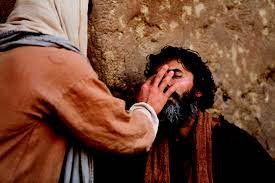
Jesus spat on the ground and made clay with saliva. He anointed the eyes of the blind man with the clay and said to him, “Go wash in the pool of Siloam.”
Jesus healed a man who had spent his life in physical darkness.
Now in earlier miracles, He just spoke the Word and the person was healed. In this case, He made clay with dirt and saliva, put it on the man’s eyes, and told him to go wash in the pool.
Maybe He just wanted to see if the man would be obedient. I really don’t know why He didn’t just speak the word in this case, but He didn’t. He told him to go to the pool.
So the man went and washed and returned.
There was the miracle.
The neighbors and those who had previously seen that he was blind discovered that he could now see. They said, “This is not he who said.” While some others said, “This is he.” and still others said, “He is like him, but it is not him.”
Finally, the man spoke up and said, “I am he.” They asked, “How were your eyes open?” He answered, “The man called Jesus made clay, anointed my eyes, and said to me, ‘Go to the pool of Siloam and wash.’ So I went away and washed and I received my sight.” Then he said to him, “Where is He?”
You’ll see that we’re going to move into an investigation.
The Investigation
Sometimes investigations are for the real purpose of trying to find the truth. Sometimes they’re fishing around to see if something can be found to bring an accusation of wrongdoing. An investigation into the healing of this blind man was about to begin.
In verses 13-18, we see the Pharisees begin to investigate Jesus.
The man who had been healed was taken to the Pharisees.
You see, it was the Sabbath day when Jesus made the clay and opened his eyes. Therefore, the Pharisees also asked how he received his sight. He said to them, “He put clay on my eyes, and I was blind and now I see.” Some of the Pharisees said, “This man is not from God. because He does not keep the Sabbath day.”
The Pharisees felt compelled to investigate.
They didn’t realize that they were talking to the man who created the Sabbath day. Jesus said He created the Sabbath for man, not man for the Sabbath. (Mark 2:27)
Jesus gave us some instructions about the Sabbath day. He said you are to do good on the Sabbath. (Matthew 12:12) It was good to heal a man who had been blind from birth…it was good to do that.
But the Pharisees came and were being very legalistic about the Sabbath day, They were actually just using that as an excuse to accuse Jesus, so they said this Man was not from God, because He did not keep the Sabbath.
As I said, Jesus is the Lord of the Sabbath.
Jesus asked them, “How can a man who is a sinner do such signs?” See, they were looking at Jesus as being just a man.
A division arose among them and then they asked the (formerly) blind man again, “What do you say about Him since He opened your eyes? He said, “He is a prophet.”
Well, the Jews did not believe that he had been blind and received his sight so they needed to confirm that this indeed was a man who was blind from birth and they were going to get the confirmation even though it was a fearful confirmation.
Fearful Confirmation
This part of the event is found in verses 19-23.
The Pharisees spoke with the man’s parents to confirm that it was indeed their son. They asked them, “Is this your son, whom you say was born blind? How then does he now see?” The parents answered, ” We know this is our son. But how he now sees, we do not know. Who opened his eyes we do not know. He is of age. Ask him. He will speak for himself.”
The man’s parents were nervous.
His parents answered this way because they feared the Jews, for the Jews had said that if anyone would say that Jesus was the Christ, that person would be put out of the synagogue.
There was confirmation from the parents, who knew better than anyone else, that this indeed was their son. They also knew that he was blind from birth. They knew that he was not a con man going around begging, but they knew about him being blind. Now he could see.
What a wonderful miracle they had experienced! But because of the Pharisees, they feared that if they said too much about who Jesus was, they would be put out of the synagogue.
We need to be bold in our witness for Jesus and in standing up for Him.
So we’ve had the events, the investigation, the fearful confirmation here.
Troubling Testimony
Now we’ve come to a troubling testimony in verses 24-34.
You saw that his parents said, “He is of age, ask him.”
So they called the man who had been blind and said to him, “Give glory to God. We know that this man Jesus is a sinner.” He said, “I do not know if he is a sinner. I just know one thing. I was blind, but now I see.”
There can be a lot of things that people can bring up and try to trip you up about your faith in Jesus Christ, but there is one thing you know: Jesus Christ came to you and restored you.
Maybe you were spiritually blind and in darkness, but you came out of your blindness. You came out of your darkness into His marvelous light.
The Pharisees continued to question the man. They asked again, “What did He do to you? How did He open your eyes? He answered them, “I told you already and you did not listen. Why do you want to hear it again?” (I don’t know if he knew that he was playing with them a little bit here but it’s kind of like he was) “Do you also want to become his disciples?” Well, that infuriated them, so then they turned on him, insulted him, and said, “You are his disciple. We are Moses’s. We know that God has spoken to Moses. As for this fellow, we do not know where He is from.
The Pharisees had some questions for the healed man.
Some of them knew that he was from Nazareth. Some of his disciples had said “Can any good thing come from Nazareth?” (John 1:44-46)
The man answered, “Well, here is an amazing thing. You do not know where He is from, and yet He opened my eyes. We know that God does not listen to sinners but if anyone is a worshipper of God, and does His will, He hears him.”
This man turned their words back on. He said, “You’re saying that this man is a sinner, but we know that from your teaching that God does not listen to sinners. But He listened to this Man’s prayer because my eyes are now open. He hears Him. Since the world began it has never been heard that anyone opened the eyes of someone blind. If this man were not from God, He could do nothing.”
They answered him, “You were completely born in sin. Are you teaching us?” and they threw him out.
That troubling testimony was the man who said “I know one thing I couldn’t see and now I can.”
Salvation and Spiritual Healing
Next, I’ll discuss a true conversion, which is found in verses 35-41
You see, the man received his sight, which is good. That was a glorious day for him – he was no longer in physical darkness. But he needed something else: He needed his sins to be forgiven. He needed to be brought out of that spiritual darkness that we are all in until we receive Jesus.
He needed deliverance from spiritual darkness.
Jesus heard that they had thrown him out. When He found him, He asked, “Do you believe in the Son of God?” He responded, “Who is the Lord that I believe in Him?” Jesus said, “You have seen Him.” (So it had to be recent because he hadn’t able to see, physically, for very long.) “You have seen Him and it is He who speaks with you.”
You may see a TV documentary about Christianity and some so-called expert religious will make the statement that Jesus never claimed to be God, or that Jesus never claimed to be the Son of God, or never claimed to be the Messiah.
You can just bring them right to the ninth chapter of John, and tell them that they don’t know what they’re talking about. Remember, if they don’t know what they’re talking about in that regard, then you don’t need to pay attention to the other stuff they’re saying, like trying to downplay the miracles of Jesus or His divinity.
Jesus made the claim here though, that “I. It is He who speaks with you.” In other words, He’s saying, “I am the Son of God.”
God or Man?
God or just a man?
Either He made a false claim or a true claim. If He made a true claim, and it was really true, then that’s fine. But if He made a false claim, there are some problems here with people who want to say, “Well, Jesus was not God, but He was a good teacher or a good moral man.”
Let me tell you some problems with that. If Jesus said, “I am the Son of God.” and it was a false statement, you have two possibilities. Either He knew He was making a false statement, or He didn’t know He was making a false statement.
If he claimed to be God and was not, He didn’t know He was not.
Then there is a problem with saying that He was a great teacher. If He didn’t even know who He is. then He didn’t know that.
The other one is that if He truly thought he was God but He was not, people would say that He was crazy.
If He made a false statement, He would have known that it was false, so He would be a liar. A liar would not be a great teacher or a great example of morality.
You can’t have it both ways, saying that Jesus is a good teacher or a good man, but He was not God.
CS Lewis put forth this argument: He said He was either Lord, liar or lunatic. It had to be one of those since He claimed to be God.
If it was true that He was God, He was the Lord.
If He claimed to be God, and it was false, but He didn’t know it was false, then He was a lunatic.
If He claimed to be God, and He knew that His claim was false, then He was a liar.
He was indeed the Lord God.
Out of Darkness
So the man who had been healed had the opportunity to hear. He had come out of physical darkness into the light, and now he had the opportunity to step out of spiritual darkness and to the light of salvation-the light of Jesus Christ.
The man said, “Lord, I believe.” and worshipped Jesus.
Jesus offers freedom from spiritual darkness.
Jesus said, “I came into this world for judgment, that those who do not see may see.”
So those who are walking in spiritual darkness, when they hear the words of God from the Bible, or hear the teachings of Jesus, have the opportunity to see and to have those spiritual highs.
But He also said that those who see may become blind. There are none so blind as those who will not see. The prophet Jeremiah made a statement similar to that. (Jeremiah 5:21) .
But here were the Pharisees. They were choosing to be blind. They were going to become blind because they would not see the truth.
Jesus knew, though, that they were claiming that they could see. He told them that if they were doing this in ignorance, then that would be one thing.
Some of the Pharisees who were with Him heard these words and said, “Are we also blind?” and of course they were, because they were not accepting Jesus.
But He used their words when they claimed that they had great spiritual insight. He said, “If you were blind, you would have no sin.” ( In other words, it would not be a conscious sin. on your part) “But you say you see, therefore, your sin remains.”
So you’ve seen the event, the investigation, the fearful confirmation, the troubling testimony, and the true conversion of the man who was born blind.
Let’s go back to the sailor who was strapped to the wheel that was trying to steer the ship. He was born in the 1700s. Both his mother and father were present in the home, although his father had to be gone quite often because his father was a seafaring man.
Now his mother was a Puritan. She was a Christian. She had songs that were children’s songs. She talked to her son. He was young, and she also had him memorize some Bible verses, but the father had to be gone for a month, two months, and, on one occasion, three years. The young boy did not see his father often but his parents were married, not separated. When the father wasn’t traveling for work, they were both present in the home.
Once, when the father was away during one of his voyages, the boy’s mother got tuberculosis, and the mother who loved this boy so much died.
After that, the boy started getting resentful. Then his father got remarried. So then he has a stepmother. History doesn’t tell us if the stepmother was evil or kind.
She just was not the one that he loved, the one that had raised him.
Then he was sent off to boarding schools, so his resentment continued to grow. He became rebellious and caused problems wherever he was.
By the time he was 11 years old, his father decided to pull him out of boarding school and take him to sea with him.
So this 11-year-old boy started on the sea voyage as well. He spent time around men who were not a good influence and their language was terrible. He picked that up quickly and could cuss with the best of them.
Through all of that, he started drifting away from his mother’s earlier teachings. In addition, he was resentful that his mother had been taken away from him.
Well, this went on for years, until the father retired. THe son had learned the art of sailing, and he was conscripted to be a sailor in the Royal Navy. He didn’t like it. He disliked it so much that he wanted to desert but when he tried, he couldn’t get away with it.
He spent a lot
Then he got the thought to ask for a transfer to another ship. Now there was a problem with this other ship: It was involved in what we today would call human trafficking. They were going to other countries, buying people, and bringing them back and selling them. We call that slavery. So, he was put on a slave ship.
Well when he got on the slave ship, again, he was rebellious against the captain. He started writing and found that he could write poetry. Well, he wrote derogatory poems about the captain. The problem was that some of the crew picked those up too, and started reciting them.
The captain wasn’t happy with that, so took him and gave him to a slave trader He was put in with the rest of the people that he had trafficked to his country. While he wasn’t a slave himself, he stayed in the situation for two years, until his father heard what was going on and sent a friend to try to rescue him.
I don’t know if the friend was able to negotiate his release, or how he got him released, but he was indeed released.
He then became the captain of a couple of those slave ships but was a crew member at another time. and that’s where we were when I started this post.
He had time to think during the storm.
He was a crew member, the storm was going the sails had been ripped to shreds, and they were having to manually pump the water out of the ship. They were all exhausted. He saw people swept overboard, and so we asked to be tied to the wheel that would steer the ship.
They complied with his request. The storm went on terribly, and he was there for eleven hours. During that time, he got to contemplate his life. He thought about what his mother had taught him. Some of those scripture verses that he had memorized as a child may have come back to him. Even though he was one of the most profane crew members, in recent weeks, he had read some Christian literature.
He realized that they were not going to survive the storm unless it were for God’s mercy. Somebody cried out for mercy to the Lord. Later on, he pointed to this as his time of conversion.
Some of the cargo in the ship shifted and blocked the hole so the water could not come in with such force, and the pumps began to work better.
Finally, the storm subsided and they were saved.
His spiritual growth was not instantaneous, though. Even though he called upon the Lord, he was still involved in human trafficking.
He was the captain of a couple of more ships that were involved in this, but he became more and more convicted about this not being the proper way to treat other human beings. In fact, even though he was taking people to be delivered, he instructed his crew members to treat them more kindly than he had ever instructed anyone before.
Then he had a stroke and could not return to the sea.
The man’s name was John. John married his childhood sweetheart whose name was Mary, but ent by the nickname Polly.
The two became more and more convinced that the slave trade was wrong. He was no longer captaining those ships, and didn’t know what he could do about it.
He had started studying Latin and Hebrew and Greek. He then felt that maybe he should be a minister, but since he didn’t have a college education, he couldn’t be appointed to one through the official channels.
But remember, his mother was outside of the official channels anyway. She was not part of the Church of England.
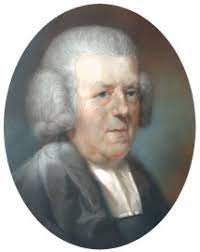
John Newton
John talked to someone who appointed him to be in charge of a local congregation. In other words, he became a preacher. He met some of the great preachers of that day. John Wesley, George Whitfield, and some of the other great preachers of that day.
Then he met a man who was a high official and the government named William Wilberforce. John Newton told William, “You know, I was not involved in the proper thing. In fact, what I did was terrible. It is legal here in England, but it ought to be outlawed.”
Year after year, Mr. Wilberforce tried to get laws passed that would make slavery illegal. Finally, before John died at 82 years of age, England outlawed slavery.
Let’s back up a little bit though, to 1772. While John Newton was going about this, he met a song leader. He realized that those poems that he could write earlier, he could write for the Lord now, and started writing poems that became songs.
He became friends with a man named William Cowper (pronounced “Cooper”) You may know him. He is the one who wrote the song “There Is a Fountain Filled With Blood”
He and Mr. Newton started writing poems that became songs, and they had a songbook compiled that had hundreds of their works in it..
I was blind but now I see.
In 1772, in preparation for their midweek prayer service, John Newton wrote a poem: “Amazing Grace, how sweet the sound That saved a wretch like me. I once was lost, But now I’m found Was blind but now I see.”
John Newton had personally come out of that spiritual darkness into the glorious life of Jesus Christ.
If you are walking in darkness and have never come to Jesus, you can escape the darkness today. You just need to call upon Him. The Bible tells us that if you believe in your heart that God raised Jesus from the dead, you shall be saved. (Romans 10:9) The Scriptures further solidify it by saying that if you call upon the name of the Lord, you shall be saved. (Romans 10:13)
I urge you to find a place to get alone with God and call upon the Lord and ask Him to save you and to bring you out of that spiritual darkness and to His glorious light.
For more sermon blogs and other faith-based items, please click here.
To watch sermon videos, visit my Rumble or YouTube channels.
I have a question for you: What are your short-term goals when it comes to meeting your spouse’s needs?
Vlog
Recap
The last few blog posts have been working on steps toward meeting each other’s needs in marriage. This is a further breakdown of step four.
The first thing you did is come up with a list of needs. You ranked each of those needs in order of importance to you, and so did your spouse. You then traded those lists with each other.
Next, you used the information in the list and those to help you understand your spouse better.
Now you’re actually into the nitty gritty of working toward projects or actions that will help you accomplish the goal of making your spouse feel better about marriage.
The reason why they will feel better about it is that their needs will be met.
I’m talking about making adjustments to your time focus.
Time is the stuff that life is made of. If you can not put in the time, you can not put in life.
In the first part of making adjustments to time focus, I said that you need to reorder things now that you’ve found out what is important to your spouse. Depending on how much of a revelation that was for you, you may find that you need to reorder your priorities.
The last post talked about looking at your long-term goals. The long-term goals came from the lifetime goals broken down into yearly goals, and the yearly goals were broken down into quarterly goals.
Go From Quarterly to Weekly to Daily Goals
Now you want to work with your short-term goals.
To come up with those short-term goals, take the quarterly goals and break them down to weekly ones. They should be the same for the week, just different projects you do on a daily basis.
The end result should be daily goals.
So you go from quarterly to weekly to daily.
Cut Items Where Necessary
Once you have done that, you’ll more than likely have to cut something out of your already busy schedule.
Now, if you have the freedom in your schedule where you can add things, for example, if you’re retired, then you have more time flexibility. If you work for yourself and you’ve done all the hard work, and you’re past the stage where you’re working 80 hours a week on a business, you may have a more flexible schedule.
Sometimes some trimming is needed.
Otherwise, you may have to find something to cut out. It may be that it will be something you enjoy doing. But you are putting a higher priority on your marriage and your spouse and helping to meet your spouse’s needs.
Once you’ve looked at your schedule and found where you need to cut some things out, it’s time to add in some projects.
Schedule Ideas and Actions
At least a few times a week, ideally, you would be working on projects that will improve your spouse’s feelings about your marriage.
You could just go down his or her list and find something that has become apparent that you have not done as well as perhaps you thought you had. Maybe you hadn’t really realized how important that item was to your spouse.
So between your clients and your schedule, include time for daily projects to work on all of those things that your spouse may have a need for.
Recreation is a case where one or the other of you have engaged in that you might start looking for ways to add recreational activities and to your weekly schedule.
Maybe watch a romantic movie together.
If you are a husband and your wife has a need for affection and romance, you might want to bite the bullet and perhaps watch a romantic movie together. That is something I do for my wife. She enjoys watching those movies, so I will watch them with her. Although, I really do like them, too. (Just don’t let the rest of the men hear me say that.) But it’s mostly about spending time together.
You could find something different that you can do in the area of showing affection. If you do not kiss your wife very often, you might make a list saying, “I learned to kiss my wife at three different times during the day.”
Those are just some examples of schedules of ideas. One man figured out that a very good thing he could do for his wife was to leave work at 5:30. He found out that they probably weren’t going to get all the work done anyway, so it was silly staying 2 hours later trying to get it done. It was better for him to go home and spend time with his wife. The work would still be there in the morning.
Those are some examples of how you can try to come up with daily goals or projects that would help you to meet your husband or wife’s most important needs.
I hope this has been helpful to you.
If you would like more tips on marriage, or to see the preceding posts in this series, just click here to be taken to all my blog posts about marriage.
There are more books planned, as well. The next book to come out will be about valuing your spouse and the one following that will deal with physical and spiritual intimacy. Watch for those coming soon.
Thanks for reading. I’m Randy Carney, wishing you the best in your marriage.